Vignettes
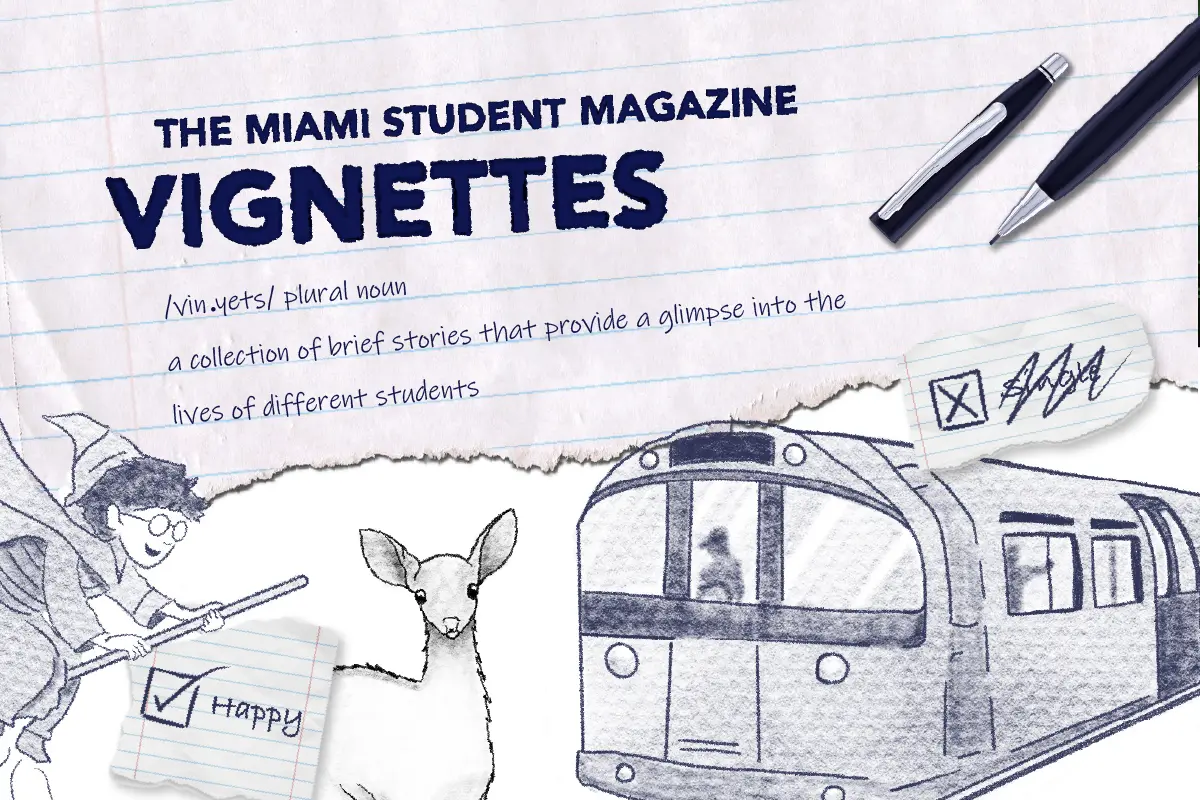
A collection of brief stories that provide a glimpse into the lives of different students
Shannon Mahoney, Kat Hippe, Parker Green, Molly Fahy
Drew Koewler
Cross-continental connections
Shannon Mahoney
Tulips
My second day in London, I boarded an unfamiliar train on the Northern Line, praying I’d know where to get off. I couldn’t stop staring at all the people flooding in and out of the carriage at regular intervals like some sort of choreographed dance.
I was ogling a businessman sitting across from me when a woman stepped into the carriage. She danced through the maze of bodies, looking for a place to stand and trampling on my foot in the process. She apologized profusely. In her arms was a bouquet of yellow tulips, which are my favorite. She apologized again, but I was still staring at the flowers, held at my eye level. They were bright and organic and looked out of place under the yellowed aging lights.
It’s an easy series of coincidences. A woman stepped on my foot. She apologized, but she didn’t need to. There was already an apology, laid out in the form of flowers, bright and glittering, below the ground in a city that is alive, always and everywhere.
Dress blacks
By the time Juliet drew her last breath on stage, the sun had already set. I left the Globe Theatre and migrated with the mass of bodies to the nearest tube station. The trains had dwindled in number, running less frequently as the hours wore on, so everyone crowded together on the platform. People stood in clusters, backs to backs, trying to carve out space for their groups wherever possible.
Five feet from me, two people, both dressed in concert blacks, swayed gently together. The girl shouldered a large case with a stringed instrument. They looked at each other so completely that it was easy to imagine no one else was even on the platform.
The boy said something that made the girl laugh. They started to hum a song together, and I strained to hear the melody. It was quickly covered up by the buzz of the tracks as the train pulled in.
Piano
My friends and I sat outside a Blank Street Coffee in St. Pancras Station at 6:50 a.m., waiting for a train to Paris. I sipped my drink and ate a pastry while desperately trying to keep my eyes open. Even the air in the station was still, and you could hear the echo of shoes off the walls when a small group of travelers walked by. Two men appeared and stationed themselves at a public piano.
One man sat down and played something classical I couldn’t identify, but my friends from home would’ve been able to. The music echoed around the empty stretch of space, and I found myself nostalgic for the heft of sheet music in my hand. The man picked another song, “The Girl with the Flaxen Hair,” a Debussy piece I had learned and loved. For a second, I swore I could see the notes in my mind.
After the song, the man turned around and disappeared into the daybreak. My friends and I boarded a train to another country. What remained was a fact: I was much changed. In other countries where everything, including my sense of self, is transient and temporary, we find our same humanity reflected in strangers.
This too shall pass
Kathryn Hippe
The heat clings — thick, damp, unyielding. It drapes over me like a second skin, humming and pulsing. Swelling to my cheeks, it beads in droplets across my forehead. My hair hangs limply. I blink once, twice.
Laughter rings nearby, spilling through the summer air. The voices are familiar yet distant, as if water is cushioning them. I reach for them, but a heavy resistance blocks me — the heat solidifying between us.
Thump.
It pulls me back — the hot, humid air pressing closer. It gathers lumps at the base of my throat, each breath sticking before it escapes.
Thump.
With the shutter of my breath, I attempt to push the air down, but it feeds and festers, churning something unseen. I try to hold it — one, two, three...
Thump.
I start again: one, two, three...
Thum –
My head snaps up, my gaze slicing through the haze as the laughter drifts along intangible currents, rippling with a gentle ebb and swell. My eyebrows furrow in unease.
Don’t they feel the heat?
Tick
I stumble backward, breath hitching as their eyes find mine. Their laughter twists, sharpening into something fractured, something pointed at me.
I reel, shielding my face as a dark blur cuts across my vision. Roaring gusts of wings swallow their laughter, heat curling around me. I scramble to my feet, eyes darting skyward as a murder of crows circles, churning the heat into pools overhead.
Wings whip and bite as I crumble, arms rising overhead.
Tick
I start again: one, two, three...
Tick
Once more: one, two… tick...
I think I’m still counting, but the words falter, my lips shaping the sound instead. I can’t remember how long I've been crouching, rocking — whispering faintly as the chime hums in my chest, no longer able to tell where the noise ends and my own chanting begins. My ears twitch at a rustle nearby. Untangling my arms from around myself, I scan the sky, only to meet an indifferent, pale gray expanse.
I could have sworn —
My ears twitch again, the sounds echoing and displacing. My head snaps to where my friends once were, expecting familiar faces — but they are gone. A brittle snapping of leaves draws my gaze to a fawn, staring blankly from the nearby treeline.
Exasperated, I wipe at the nape of my neck — the sweat cold against my skin as it prickles under my fingertips.
I shiver, the cold gnawing at my sleeves as I draw them tighter around me.
A white fog blooms before me, dissipating into the chilled air; I am suddenly aware of my breath.
A gentle breeze stirs among the branches — once adorned with pillows of green and pink, now bare and brittle. Thin currents lift the remaining leaves, sending them spiraling lazily while teasing my hair in wisps around my face.
Winter. I consider pinching myself.
Then I blink, and it's gone.
Untried in spirit, the trees remain rooted and unbothered, the sparrows continue chirping, the flowers bloom and wither with the changing seasons — all subject to a slow reminder that this too shall pass.
I am reminded that this too shall pass.
Life is not a rom-com
Parker Green
My parents met in kindergarten, became best friends in middle school and started dating after ditching their junior prom dates to hang out together instead. They went long distance in college, moved to New York City together, got married, had me and my three siblings and have been blissfully in love for a grand total of 31 years and counting.
It’s adorable: the kind of story that gets pitched as a cheesy, aspirational rom-com.
My own love life, however, is completely different. In fact, it’s entirely nonexistent and has been for 20 years. Sure, there’s been the odd talking-only situationships, but for the most part, I’ve been chronically, tragically single.
It’s not that I don’t want to date; I like the idea of a romantic relationship conceptually. But dating is hard.
College men are confusing, exotic creatures, similar to a poison dart frog: pretty to look at, but best kept far away from your physical person (and preferably released back to their natural habitat after careful observation).
Even if I were to brave the dating pool, it’s hard to find someone I like. Classes, extracurriculars and even bars seem to be filled with some combination of red flags, happy couples and others generally uninterested in me.
And yet, when I turn on my phone and gossip with my friends, I’m swarmed with “#couplegoals” and “Did you hear she found a new man after getting dumped three days ago?”
It’s easy to feel left behind, like everyone is experiencing the joy of romantic love while I fade into cat-lady levels of obscurity. There are days when my insecurities run rampant: What if the reason I haven’t dated anyone is because I’m not pretty enough, not interesting enough, not good enough for actual love?
I don’t want to be alone; I don’t want to be cast aside.
It’s a rabbit hole that is too easy to fall into, and these insecurities, for lack of a better word, suck.
But do you know what doesn’t suck? Actually being single.
I love my friends and family. I love reading for hours on end. I love my job, spending entire days wandering and having alone time. No one has ever cheated on me, told me I couldn’t wear my cute going-out top or invaded my privacy (as some of my friends have experienced). I am, for the most part, fulfilled and happy with my life.
A lot of my desire for a relationship is fueled by this fear of being alone or my own insecurities. If you genuinely like someone, you should date them. But I wonder if people would be happier if they just let go of the all-consuming desire to date, and instead focused on every type of love, knowing that romantic love can come at any time.
I am not lonely because I don’t have a boyfriend. I’m not lonely at all. When I decide to date somebody, it will be because they add value to my life, not because I’m looking to check a box on some giant life list. Being single is not a character flaw I have to overcome.
So whether you see me out and flirting up a storm, laughing my ass off with my two best friends or quietly reading in blissful silence, know that I am exactly where I want to be.
The future may be uncertain, but I do know one thing: single or taken, it will be full of love.
Library of life
Molly Fahy
Ever since I was young, my dad, no matter how late he’d come home from work or how tired he was, would always take the time to read to me each night.
There was something about the enthusiasm my dad had for reading stories out loud that captivated me — he didn’t do any special voices, but there was an unmistakable passion.
And in those hours we spent together, his love for books eventually started to rub off on me.
Before I could read on my own, I would gravitate to books for their pictures. Whether it was Winnie the Pooh, Curious George or another lovable character, I would stare at the illustrations for hours.
Then, when I was 4 and a half years old, I got sick. Suddenly, I was spending most of my days in the hospital. This meant that when I turned 5 and was supposed to start kindergarten, I couldn’t.
My mother, a former teacher, decided she would teach me the basics herself. Soon, I started reading early nursery rhymes and short stories with ease.
When I reached kindergarten, the teachers and staff were surprised to learn that I was advanced; in fact, my reading level was at least a grade above my classmates.
My mom started to fuel my addiction. She would constantly buy me books — even ones that were far above my level — just because she knew I would be able to comprehend them soon enough.
However, in second grade, something life-changing happened.
At the first book fair of the year, I decided to buy “Harry Potter and the Sorcerer’s Stone.” Something about magic and a boy with a mysterious past intrigued me.
Although it is considered a fourth-fifth-grade level book, I finished the 320-page story in just two days. I loved it so much that it eventually had to be held together by duct tape.
After that, it was not unusual for my parents to find me slacking off on my chores with a book. More than one teacher told me not to read and walk at the same time. I was consuming stories at a voracious pace, too; I’d finish a 300-page novel in just a few hours.
Unfortunately, as I’ve grown older and school continues to consume all my waking hours, the voracious reader I was as a child has become considerably less so. I often don’t have the time or energy to dip into a dense novel.
But that doesn’t mean I’ve given up on literature. Now, I can be found reading short stories and plays that friends have written, sharing my thoughts and opinions.
I often exchange recommendations with my dad, my original champion of reading. He loves books about history and politics, and since I am studying both political science and journalism, we often enjoy the same books now.
It’s in these moments that I realize the little girl who used to be surrounded by piles of books is still there. It’s the girl who would gladly spend a weekend reading instead of going out, who can quote Jane Austen at the drop of a hat and who completely loses herself in a world that exists somewhere between real and make-believe.

