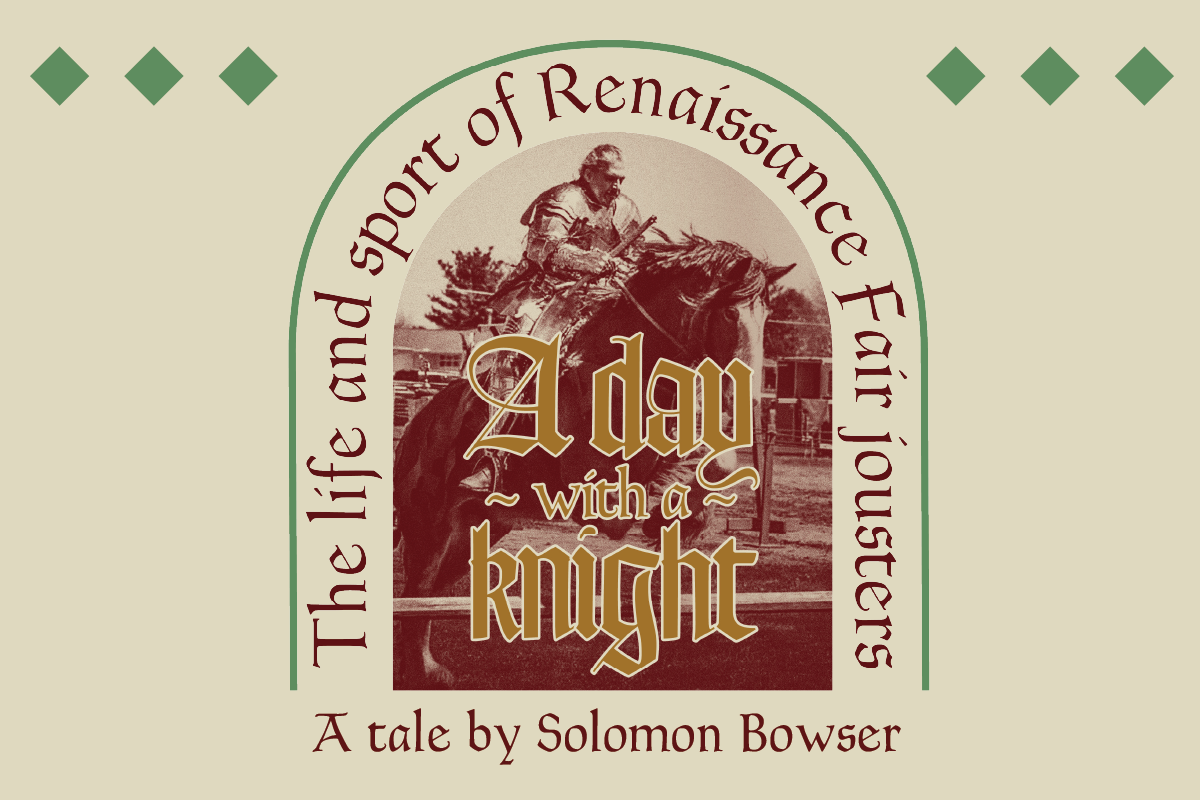
A day with a knight
The life and sport of Renaissance Fair jousters
Solomon Bowser
Jayson Brake
It’s midday — almost time.
Troves of soon-to-be spectators have already gathered across rows of wooden benches and patches of open grass. If not for the arena sitting in front of them, the crowd itself could serve as its own spectacle.
A rainbow array of costumed characters fan out from the arena’s edge, and the eye wanders from warriors adorned in armor and weapons to fairies decked out in flower crowns and butterfly wings. Even the odd pauper or poet can be found dressed in a leather corset or wool beret.
Several obstacles and targets are set up on the long sandy track, laden with foot and hoof prints. Across from the audience, there’s a sort of faux-medieval structure that runs the length of the arena. It’s made to look like those old lumber-built houses that carpenters would cover with clay and plaster. There are a few rows of seats built into it on either side of a decadent-looking throne. It’s still empty, but the thrum of bagpipes and beating drums in the distance gets louder each second.
The royal parade approaches; a cavalcade of medieval characters makes its way through swathes of passers-by, all led by the queen. As it stops at the arena, the seats of the far structure have already filled with new audience members, save the throne, in which the queen promptly takes a seat. Three knights, all on horseback, ride into view. They dismount to bow before the queen, and a pair of marshals walk out to welcome the crowd to the Ohio Renaissance Festival.
The first marshal to speak introduces this part of the festival — a joust — as an activity done during times of peace to keep knights in good form, mentally and physically. With some light banter between him and his co-star, donned in this roguish black attire, he addresses the crowd.
“Ladies and gentlemen, would you meet your knights?”
The crowd offers up some cheers. The second marshal interjects; he isn’t satisfied with this response.
“Ladies and gentlemen,” the announcer repeats with a booming voice across the arena, “would you meet your knights?”
The crowd roars this time.
Each knight introduces themselves.
Sir Samuel, the youngest of the group, races by the crowd atop a silvery-white horse called Damascus, waving his blue beret, the shine of his pristine armor flashing with each gallop.
Sir James, posing as the group’s bad guy, rushes past the audience on Billy with his fist raised, and a few boos can be heard amongst the crowd.
The last introduction goes to Sir Thomas Broadwarden atop his steed, Bob. He makes his round, waving his feathered cap.
The crowd offers their adoration, roaring with applause.
***
Sir Thomas’ real name is Tom Nader, and he’s been running the jousting show at the Ohio Renaissance Festival since 2021. He’s been in entertainment and historical reenactment for about 30 years, and his passion for the festival predates even that. Tom said his heart and soul will always be with the festival — it carries a little bit of everything for him, with elements of theater, history and good times with friends.
He's always held a deep fascination with medieval culture, having grown up loving stories like Robin Hood and watching movies and documentaries about the era. When he was 18, he attended the Ohio Renaissance Festival for the first time during its opening season in 1990.
“I looked around and thought, ‘Here are all these weirdos like me,’” Tom said.
From that point, Tom got more involved as a part of the act, taking on several different roles each season. He started as an assistant to a magician, who also acted as a kind of mentor while he was interning with a regional theater during college. After the magician moved on, Tom would take up a role in a pirate act, as a street-cast member and finally run his own booth giving short fencing lessons.
It wasn’t until roughly 1996 that the idea of jousting came up in a conversation with a friend. The two of them were giving critiques on the current show and decided they would give it a shot. It started small, but thanks to the connections Tom made through the festival, and with some advice from coworkers at the theater, enough stars aligned for him to start his own jousting company: Combatant’s Keep.
***
Fast forward to 2025. It’s September, the festival is in full swing and the troupe is gathering for its second morning meeting of the week.
Beyond the large wooden fence that encircles the fair lies an expanse of cars, campers, tents and shipping containers. Some staff and vendors mill about the chilly grounds, prepping for the day or just carrying conversation to pass the time. Between a small circular pen and a stable, each housing a few horses, the ensemble is getting the day started.
It’s a slow trickle-in for some members, so everyone’s in their own place at the moment. Most of the squires are already present. Jason is wrapping up tending to the horses, Christian just arrived, Kasia (a squire and knight in training) and Steven (one of the marshals) have yet to show, and Cassidy, Kai and JJ are talking with James and John (John is the other marshal).
They’re talking about some of the more interesting patrons who’ve attended in the past, most notably someone who wore a potato costume to one of their shows (and apparently nothing else).
“Dude, it looked like she wasn’t wearing anything,” Kai said. The comment elicited a few smirks and stifled laughs from everyone.
Sam, the last of the knights, rolls in after a short pit stop for breakfast, and Steven, the last marshall, has also arrived. Tom calls everyone together and starts the meeting off by letting them know that yesterday’s show went well, especially with how they introduced Damascus, the newest horse.
He goes through some reminders about the weather and how that might affect the horses (Bob hasn’t been taking the heat very well), as well as some tips for how to keep things running smoothly for the audience.
“If you can’t see how hard we are holding these horses back, then you know we’re doing our job,” Tom said.
After their meeting, they do a quick walkthrough of their positions for the day’s shows and begin prepping for the first event. They make their way down to the arena, each of them with their own responsibilities, whether it be carrying supplies or transporting the horses. Next to the arena, there’s an open space for the troupe and neighboring acts to spend the time between shows. It’s also where they keep the horses.
This space connects to the “Knight’s Encampment,” where they conduct a meet and greet for patrons to talk to the knights, see how they work on their armor and even pet Bob, who’s the most popular horse.
The next two hours are spent scrambling to prepare. Sam, James and Tom spend between 15 and 30 minutes donning their armor. The legs are the easiest part to get on, but as soon as they get above the belt, the squires have to jump in to help.
They layer one shimmering piece after the other — breastplate, shoulder, forearm — then tie everything down. Soon enough, the three of them are up and moving, clinking about like walking silverware cabinets.
On the other side, Jason and Kasia are getting whatever help they need to take care of the horses. They need to be fed, brushed or washed if appropriate, cleaned up after and fitted with their respective saddles when it comes time to mount.
The sounds of the pirate show can be heard bellowing next door while Jason and Kasia tend to the horses. There’s the usual music or lines played over the speakers, but every so often, a cannon blast will rupture the relative calm, although at this point, even the horses are used to it.
What does receive attention is James calling out “15 to mount.”
Everyone starts to finish whatever they’re doing.
“Five to mount,” This time from Steven.
The knights take turns climbing a small platform to mount their horses. At this point in the day, the sun starts to peak, and a glint appears across their armor. The gate opens up and they are off to join the royal parade.
The track is set, the knights are ready and the game begins.
The first half of the show consists of three tests of skill, each completed by riding through a set of obstacles. The first requires the knight to collect three hanging rings — about as wide as a small plate — using a spear, then land a hit on a dummy target.
Sam charges atop Damascus, spear in hand. He loops the first, second and third rings and plants the spear into the dummy’s face. The bright yellow form, already riddled with holes, teeters back on its post, hanging for just a moment before crashing down into the sand.
The second challenge requires the knights to topple a series of dummies on either side and jump their steed over a beam.
James and Billy speed through the targets, striking each one in quick succession. Billy hops over the hurdle, and James flips his weapon into the air before catching it gracefully.
The final test involves the quintain, a large wooden post holding up a beam, with a small bullseye on one end and a sack of stones balancing it on the other. The knight must hit the target while avoiding the swinging stones.
Tom takes up his lance, a bright red pole just taller than he is while on top of Bob, and takes off. He rests the handle under his arm, raising it as Bob speeds toward the quintain. Drums and trumpets rise to a crescendo in the background as he strikes the center of the target, narrowly avoiding the flailing stones.
***
Tom chose to move on from the festival in 1997. He’d gotten married and had a daughter, and he decided it was time to make some changes. They moved around a couple of times, and Tom found different jobs in substitute teaching and digital embroidery. He kept the jousting company but focused on living history and reenactments.
Tom and his wife divorced around 2018, and after staying in Kentucky for a few months, he moved back to Ohio. It was at this time that an old friend of his invited him back to the fair for its 30th anniversary. He returned to find people whom he didn’t expect to ever see again. This was how he met his current girlfriend, Jennifer, whom he really liked all those years ago.
This is how he met everyone he currently works with. This return was what tied the current group together. At one point or another for the past three decades, whether they had been with the festival or pursued some other part of renaissance life, they found each other.
Tom and his friends all share the same passion for the festival, and their connection runs deeper; they regard each other as family. They spend time together outside of the arena, going to dinners or riding horses. They call each other when they’re in a bad spot or need help.
***
With the tests of skill concluded, one of the lords asks the queen if there’s anything more she’d like to see, perhaps something more cerebral. The queen says she would prefer something more brutal.
John asks the crowd if they would like to see a joust, and the crowd responds with a healthy bout of cheering. Steven reminds everyone that the knights they're about to see have taken a few more hits to the head than the average person, so they need to be louder if they’re going to hear. The crowd responds in turn.
The knights are outfitted with helmets, each with corresponding plumage: Sam with blue, James with red and black, and Tom with blue and red. In addition, a small shield is strapped to their shoulders, which is the target they will attempt to strike.
The first round is between Tom and Sam. They each sit atop their horses at either side, and as a squire hands them their lances, they ready themselves and tear down the track. Sand tosses as the horses dig their hooves into the ground. With each step, the knights steady their lances, sunlight flashing across their chromed surfaces, plumage billowing with each thunderous move until finally, they meet.
Sam and Tom collide at the center, their lances snap like twigs against their shields, splintering at the end. They do a few more passes, riding back to their position, taking up another lance and hoping for the best as they careen toward each other.
Tom is awarded the first victory, just barely grazing Sam’s shoulder in the last pass and winning by a single point. His next round is against James, and it’s a little more challenging. The two manage to score a few solid hits, but in the last round, Tom narrowly misses James’ shield, while James lands a point and is awarded ultimate victory.
This process continues through the rest of the day. Everyone plays another two shows, gets some rest in between, rinse and repeat.
After the final show, the knights retreat into the encampment under the evening sun. They dismount, their faces red and dripping sweat, and congratulate everyone on a great performance. They spend the next half hour talking to patrons. Some fans in fantastical attire chat with Tom or James, a few kids come up to pet Bob and the knights even hand out their broken lance tips as souvenirs.
The end of the day is only a few hours away now. Everyone’s starting to feel that last-minute release; the knights have even taken off all their armor (they usually wear the leg parts throughout the whole day). There’s one word that seems to come up as everyone starts to wrap things up: “Pub-Sing.”
The very last stop for anyone during the festival is the Aleing Knight Pub, where people can grab some food, maybe a drink and watch a little musical act. The event is kicked off by the musical duo Damh and Dove playing a thundering tune on the bagpipes and bass drum; it’s not long before people are feeling the mood.
The next hour or so is a riotous display of frivolity and revelry. More people start playing music (one group busts out a didgeridoo about as tall as the guy playing it), and people get up and dance in front of the stage. Everyone’s drinking and cheering, just inhabiting the moment.
Once the band has finished its last song, the patrons are ushered to the Bridge-Sing. There’s a short wooden bridge leading over a small stream that splits the festival grounds. Members of the street-cast have lined either side of the bridge, each holding a goblet or mug, singing as the last few patrons make their way out of the festival. It’s a bittersweet song about being thankful for the moment and raising a drink to your departure, until they see you again.
After the last few people make their way across, one of the festival directors thanks the cast for all their work. Tom and the troupe return to the encampment and start to pack everything up. When they finally finish getting the horses back in the stable and everything squared away, they’ll join each other for dinner at Tom’s place.

